

Which of the Following is a Biased Estimator?
When working with statistics and estimation, understanding bias in estimators is essential. But which of the following is a biased estimator? This question often confuses beginners and even some professionals. In this blog, we will clarify what a biased estimator is, give practical examples, and explain how bias impacts your results. We will also touch on the bias versus variance trade-off, all while naturally connecting to fields like construction estimating services USA.
What is a Biased Estimator?
A biased estimator does not accurately reflect the actual value it aims to estimate. It consistently skews results in one direction, causing systematic error. For example, if you estimate the average height of a group but your method tends to produce lower values, your estimator is biased.
In contrast, an unbiased estimator’s average value equals the actual parameter across many samples. This difference is crucial in fields like construction estimating services USA, where precision impacts cost and planning.
Common Biased Estimator Examples
One classic example of a biased estimator is the sample standard deviation calculated without Bessel’s correction. The standard deviation calculated directly from a sample tends to underestimate the population standard deviation, especially with small samples. This is known as sample standard deviation bias.
Another example is when estimating a population mean but using a non-random sample that overrepresents certain groups. This sampling bias leads to inaccurate results.
Bias Versus Variance Trade-Off Estimator
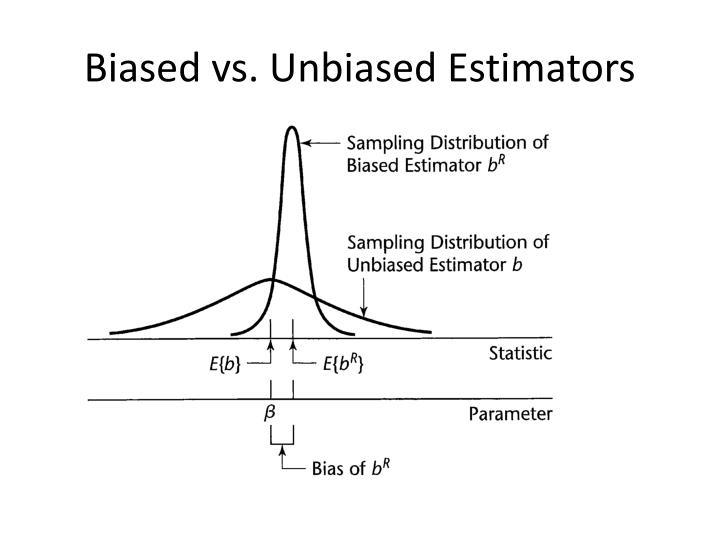
Understanding the bias versus variance trade-off is important. Bias refers to the error from incorrect assumptions, while variance reflects how much the estimator varies with different samples.
Here’s a summary in a table format for clarity:
| Aspect | Bias | Variance |
| Definition | Systematic error causing consistent deviation | Variability of estimator across samples |
Effect on Estimates | Causes estimates to be consistently off target | Estimates fluctuate widely from sample to sample |
| Goal | Minimize to avoid systematic errors | Minimize to ensure stability |
Trade-Off | Reducing bias can increase variance | Reducing variance can increase bias |
| Example | Underestimating population mean | Estimates vary greatly in different samples |
Balancing bias and variance is key to accurate estimation. Construction estimating companies USA, including Paramount Estimators, carefully manage this trade-off to deliver reliable results.
Why Does Bias Matter in Estimation?
Bias causes systematic errors, leading to incorrect conclusions or costly mistakes in real-world projects. For example, in construction estimating services USA, biased cost estimates can lead to:
- Budget overruns
- Project delays
- Poor resource allocation
At Paramount Estimators, we emphasize unbiased and accurate estimations. Our team uses refined methods to reduce bias, ensuring clients receive reliable preliminary and final cost estimates.
How to Identify and Correct Biased Estimators
Testing estimators with known data or simulations helps identify bias. Adjustments like Bessel’s correction for standard deviation or better sampling methods reduce bias.
Working with expert estimation companies in USA, like Paramount Estimators, ensures professional handling of bias issues in your construction projects.
Conclusion
Knowing which of the following is a biased estimator helps improve accuracy in statistics and industries such as construction estimating services USA. Avoiding bias reduces errors, saving time and money. Paramount Estimators specializes in precise and unbiased cost estimation services, supporting your project’s success.
FAQs
Q1: What is the main difference between biased and unbiased estimators?
Biased estimators consistently deviate from the true value, while unbiased estimators’ average value equals the true parameter.
Q2: Can biased estimators still be useful?
Yes, sometimes biased estimators have lower variance and can be preferred depending on the situation and the bias-variance trade-off.
Q3: How do construction estimating companies in the USA handle bias?
They use statistical corrections, better sampling, and advanced software to reduce bias in cost estimates.
Q4: What is sample standard deviation bias?
It refers to the tendency of the sample standard deviation (without correction) to underestimate the true population standard deviation.
Ready for Accurate, Unbiased Estimates?
Contact Paramount Estimators today for expert construction estimating services USA. Let us help you avoid costly errors and keep your project on budget.
