If your drawings are not finalized or completed anywhere between 30% to 90% by the Architect/Designer and you are concerned about the budget of the project. Then you have clicked the right place. We provide Preliminary estimates in USA based on schematic drawings by making suitable assumptions.
We use the square feet method and make detailed estimates as well. Send us the plans and we will return an estimate with a realistic budget accurate enough to support your further calculations.
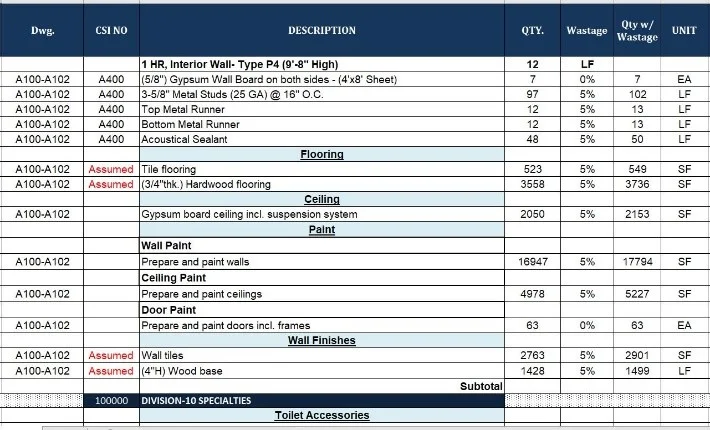
A preliminary estimate is a rough estimate of a specific value, amount or measurement depending on incomplete or inadequate information. It is an approximate calculation or estimate done at an early stage of the planning or design long before any information with a high level of detail is known. Preliminary estimating services in USA are often used to give a rough idea of cost, time or resources it would take to do a project or task, to give a general direction in decision-making during the early stages. They are normally polished and revised with additional facts provided.
Preliminary estimates are applicable in different contexts including construction activities, product development, events organization and financial estimations. They are able to form a base line of scope, budget and time of any project, as well as advise on feasibility studies and risk analysis.
It should be pointed out that such preliminary estimates are not conclusive or official and they can be greatly altered as we learn more about it. However, they represent an essential instrument to project managers and decision-makers, who have a starting point in project planning and aim to make sure the projects are aligned with the general goals and objectives.

You can also ask why the size of the sample matters. A research that has a sample size which is too small could also result in an inaccurate finding. Alternatively, gathering too much data can be of time and resource waste-terminal particularly in the construction preliminary estimate USA and project management sectors, where every minute and dollar matter. A well-calculated minimum sample size ensures that:

Normally, to calculate a minimum sample size, researchers use a preliminary estimate of:
Standard deviation (σ) – for continuous variables like weight, time, or cost.

In the case of a new home design trend, a novel material used by a home construction estimator, or a unique project handled by project scheduling consultants, historical data may not exist. That’s where material estimating services in USA often fill the gap by using benchmarks or industry knowledge.
The conservative assumption is safest in case you do not have any preliminary estimate.
Example
Suppose you’re surveying homeowners about interest in eco-friendly home materials. You have no past data, so assume p = 0.5. The result will give you the largest required sample, guaranteeing robust data.
A pilot study is a small-scale version of your full study. It helps generate initial estimates—like mean, standard deviation, or proportion—so that you can use them in your actual sample size formula.
For instance, a home construction estimator may run a pilot survey to learn what percentage of homeowners plan to renovate within the next year. That percentage becomes your preliminary estimate for the main study. Pilot studies are particularly useful for:
Although this takes extra time upfront, it can save costs and increase accuracy in the long run.
In many cases, data from similar populations can serve as substitute preliminary estimates. This method is frequently used by project scheduling consultants and engineering professionals.
Example:
If you’re researching construction delays in Texas but lack data, you can look at similar data from Florida or California. You may consult:
This approach helps approximate preliminary estimates in the USA, giving your sample size calculation more context and realism.
Sometimes, your best source is expert intuition. In fields like architecture, healthcare, or IT infrastructure, expert judgments can help guide assumptions when no prior data exists.
For example:
While this is less precise than statistical estimates, it is a practical workaround that is often accepted in feasibility or exploratory studies.
When you are uncertain with your estimates, then it is prudent that you use a broader margin of error e.g. 10% instead of 5%. This gives you better freedom to your sample size calculations.
When conducting investigatory research, you can decide to reduce the power (e.g. 0.9 to 0.8). Having this, though, poses a greater threat of committing Type II errors, but it may decrease the sample size needed.
Once initial data starts coming in, update your calculations. Refine your sample size and adjust goals accordingly.

In the world of construction and infrastructure, working with incomplete data is routine. Professionals such as home construction estimators and project scheduling consultants often begin projects with limited scope clarity, making preliminary estimates a vital skill. For example:
In these cases, using conservative assumptions, pilot studies, or expert preliminary estimators in USA helps fill the gap.

At Paramount Estimators, we understand that accurate planning starts with reliable data—even when no preliminary estimates are available. That’s why we offer comprehensive preliminary estimates designed to support home construction estimators, project scheduling consultants, and developers across the USA. Our expert team provides customized solutions that define uncertainty with confidence—through pilot project guidance and advanced estimation tools. Whether you’re in the early phases of design or tackling complex scheduling requirements, Paramount Estimators deliver accurate, cost-efficient estimates at the right time—empowering you to make informed decisions.
Conclusion
When there is still no preliminary estimate of the maximum sample size may sound intimidating, however, it is completely possible to make one. As a researcher, home construction estimator or project scheduling consultant, you can make use of a number of sound methods:
In the USA, where evidence-based decision-making has become the norm in most of the sectors, a good understanding of the approximations can provide your project or study with a significant boost.

